table of contents
- Week 1 – Introduction to Aviation
- Week 2 – Communication and Confidence
- Week 3 – Grooming and Professional Appearance
- Week 7-8: Cabin Skills (Practical)
- Final Stage – Interview and Career Preparation
- Cabin Crew Training
- Aviation Airline Training
- 1.What is the cabin crew course training?
- 2.How much do cabin crew training courses usually take in?
- 3.What exactly is a cabin crew training or course?
- 4.Is aviation training for cabin crew required for candidates?
- 5.Are they possible to get a job after class 12?
- 6.Which Subjects are taught in the classroom Cabin Crew Training?
You’ve seen cabin crew on your flights. Now, think of being one of them. What training is like — from Day 1 to your first boarding call.
If you are interested in taking up the cabin crew career, then you might have asked yourself a question like “what is cabin crew training?,” “what is cabin crew course?,” or “how long is the cabin crew training in India?”.
Training is a big part of becoming a professional flight attendant and the first step in understanding how to do this job is to go through the training. It is not just about grooming, uniform or food and drink. A sound training scheme equips candidates with the skills required to deal with passenger safety, emergencies, communication and customer service, professional behaviour and cabin duties.
What is it that students learn in their cabin crew training? How long does it take? Who can join? What is the expense of this? What will happen when you finish the class?
Here you will find all about cabin crew training in India 2026, which is a beginner’s guide.
So what is Cabin Crew Training?

Cabin crew training is a formally arranged program designed to train the candidates for the jobs of cabin crew in the airline with reference to safety, service, grooming and communication. The duration of training courses in India can vary from a few months up to a year, depending on the institute and course.
Cabin crew training programs help students develop the knowledge, skills, and professional conduct needed to serve as a flight attendant in an airline.
Typically, the training is divided into two general categories:
- Responsibilities for Safety and Emergency
- Tighten the tenets of the passenger service and professional skills.
This translates to that students have learned more than just interacting with passengers.
They might learn emergency procedures, know about aircraft safety equipment, learn the basics of first aid, communicate effectively, enhance grooming and presentation and learn how cabin crew members should handle various passenger situations.
It is also essential to know the difference between aviation institute training and airline training. A private aviation training academy can give candidates the basic knowledge and skills, and the airline can also give them the aviation training required after they have been recruited.
Airline procedures and regulations are important for airlines in India. The Directorate General of Civil Aviation (DGCA) is responsible for civil aviation safety and standards in India, and the airlines have their own procedures and training standards.
What is taught in Cabin Crew Training?
Typically, a professional cabin crew training program in India involves classroom instruction, practical activities, communication training, grooming and mock scenarios.
Although the details vary from institute to institute, generally one can assume the following areas.
1. Aviation and Cabin Crew Basics
Students should have an understanding of the aviation industry before given advanced responsibilities.
You may learn:
- Aeronautics – Introduction to the aviation industry.
- Types of airlines
- Airport terminology
- Aircraft basics
- Traffic control and meteorological duties.
- Flight crew functions and flight weather duties.
- The various kinds of airplanes
- By operating airports and airlines.
- By running airports and airlines.
- Basic aviation terminology
- On-site experience from the moment of check-in to arrival
This provides students with an overview of the function of an airline and the role of the cabin crew within the airline.
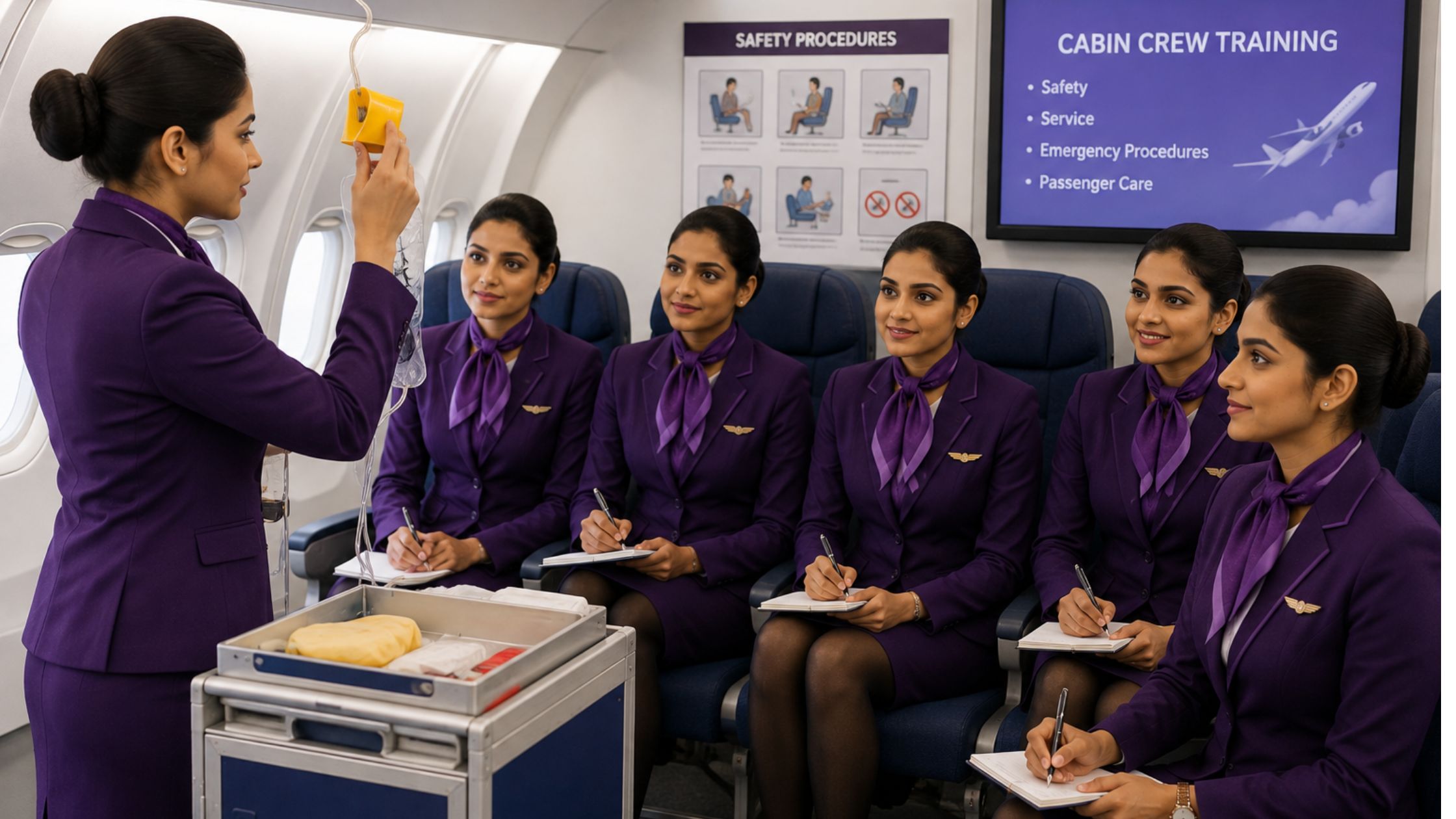
2. Safety and Emergency procedures
One of the most crucial aspects of cabin crew training is safety.
During a flight, a cabin crew member’s job is to ensure the safety of the passengers on the flight; candidates should be certain of how to react in a calm and correct manner when unexpected situations arise.
Training can include areas such as:
- Emergency procedures
- Evacuation procedures
- Safety demonstrations
- Aircraft safety equipment
- Emergency exits
- Passenger safety instructions
- Fire and smoke drills
- Basic survival procedures
- Water-related emergency procedures
- Handling unexpected situations
Students can additionally take part in real-life scenarios or exercises to gain insight into the function of emergency procedures.
That’s why a cabin crew is not just a customer service job. Safety is an integral part of the task.
3. First Aid & Basic Medical Response
Passengers may become unwell while in the cabin during a flight and cabin crew may be called upon to assist them.
As a result, training usually includes an introduction to basic medical and first-aid skills.
Students may learn about: (depending on programme)
- Basic first aid
- Dealing with typical problems of the passengers’ health
- Responding to injuries
- Basic CPR awareness
- Medical emergencies onboard
- Responding to emergencies by communicating with suitable staff.
The aim is not to make cabin crew doctors. Candidates are taught to deal correctly with a passenger in a need for assistance and to comply with procedures.
4. Passenger Service Training
Another large aspect of the cabin crew training course is the passenger service.
Cabin crew communicate with a wide range of individuals, including the elderly, people of diverse cultures and expectations, and age groups.
Students can thus be taught:
- Passenger handling
- In-flight service
- Food and beverage service.
- Professional communication
- Handling passenger requests
- Complaint management
- Conflict management
- Hospitality standards
- Cultural awareness
- Professional etiquette
Emphasis is placed on safety and professionalism and efficient service is provided.
5. Communication Skills
Effective communication is very vital to a cabin crew.
A cabin crew must be able to communicate clearly with passengers and fellow crew, the pilots, airport personnel and other airline employees.
The training can be based on:
- Spoken English
- Professional English
- Pronunciation
- Vocabulary
- Public speaking
- Listening skills
- Telephone etiquette
- Passenger conversations
- Announcements
- Confidence building
It’s not a requirement for candidates to speak fluent English right away.
However, they should be prepared to work on their communication skills and make themselves at ease in communicating clearly and professionally.
6. Information on the Positive Outcomes of Early Childhood Education
The first thing that comes to mind for most individuals looking up “what is cabin crew course?” is grooming.
Whilst grooming is definitely included in many training for cabin crew programs, it’s just one aspect of the training.
Students may learn:
- Professional appearance
- Personal grooming
- The basics of caring for your hair and skin.
- Professional makeup
- Uniform etiquette
- Posture
- Body language
- Professional manners
- Interview presentation
- Confidence
Group discussions, presentations, role-plays and mock interviews can also be used as personality development activities.
The objective is not to alter a person’s character.
In contrast, students are taught to make a professional impression in an airline setting.
7. In-Flight Announcements
Have you ever heard an announcement for take-off or ‘flight announcement’ before?
The sound of the announcer’s voice should be clear, confident with correct pronunciation and professional.
Students may practise:
- Welcome announcements
- Safety announcements
- Boarding-related communication
- Turbulence announcements
- Service announcements
- Arrival announcements
Practical Speaking is to enable the candidates to become familiar with group speaking.
8. Problem Resolution
Not all of the people who travel on the bus are easy.
It could be a passenger’s dissatisfaction with the delayed flight, seat assignment, meal, baggage or any other area.
As a result, after undergoing cabin crew training, the students are able to deal with difficult situations professionally.
Students will be able to:
- Listen but do not further aggravate
- Maintain a calm and relaxed attitude during stressful times
- Communicate politely
- Understand passenger concerns
- Follow airline procedures
- Handle complaints professionally
- Be courteous to other members of the ship’s crew
Remaining professional, irrespective of any situations, is one of the most important skills to learn by all cabin crew.
The idea of Cabins Crew Training: A Week-by-Week Example will be explored.

The schedule would be determined by the institute and programme but a basic training schedule for novice might be like the following:
Week 1 – Introduction to Aviation
This week it’s back to the basics of aviation.
Students will learn to know about:
- Aviation industry basics
- Airline operations
- Cabin crew responsibilities
- Airport terminology
- Aircraft basics
The emphasis is on gaining knowledge of the industry prior to specialisation training.
Week 2 – Communication and Confidence
Each week topics will be discussed, e.g. Communication and Confidence.
Students begin developing:
- Spoken English
- Professional communication
- Public speaking
- Presentation skills
- Listening skills
Discussing and rehearsing speech/presentation in groups.
Week 3 – Grooming and Professional Appearance
Students will be able to professionally groom in a grooming area.
The emphasis is on:
- Personal grooming
- Professional appearance
- Body language
- Posture
- Workplace etiquette
Pupils begin to appreciate the need to be professionally presented in order to build up passenger confidence.
Week 4 – Passenger Service
Students explore:
- Passenger interaction
- Hospitality
- Food and food or drink services.
- Handling requests
- Complaint management
Role play activities can be used to practise real life interactions with passengers.
Week 5th – 6th: Safety training and Emergency training
Safety concepts and emergency response are an important aspect of this stage.
Pupils can be taught about:
- Safety procedures
- Emergency equipment
- Evacuation concepts
- Fire safety
- Emergency communication
- Passenger safety
It can consist of simulations and/or practical activities, depending on the institute.
Week 7-8: Cabin Skills (Practical)
Week 7-8: Cabin Skills Practice.
Students can practise:
- Cabin service
- Announcements
- Passenger handling
- Safety demonstrations
- Professional communication
To connect with what they learn in the classroom with real life situations.
Final Stage – Interview and Career Preparation
In the Final Stage students will experience an interview and career preparation.
Students can use any combination of the following to write:
- Airline interviews
- Group discussions
- Personal interviews
- Resume preparation
- Self-introduction
- Professional presentation
Mock interviews can assist candidates in getting more familiar with the recruitment process.
Note: This is just a sample learning progression and not a programme week by week as stipulated by DGCA/Airlines. Length of training courses and order of training courses differ amongst institutes and airlines.
Therefore, is Cabin Crew Training In India Eligible or not?
There may be other training institutes and airline requirements.
Typically, the following are considered when determining eligibility for:
- Educational qualification
- Age
- Communication skills
- Ability to do physical and medical activities.
- Passport/travel documentation
- Airline-specific requirements
Once you complete your class 12th, all entry level jobs as a cabin crew will look for you, but the role that they will be expecting from you as a cabin crew in the line will differ.
Other requirements may apply to some airlines such as age, height/reach, medical fitness, language etc.
It’s therefore advisable to find out the requirements of the airlines you are thinking of, since the specifications are not the same for all airlines.
What is the cost of Cabin Crew Training?
The charges vary greatly from institute to institute.
The overall fees may depend on:
- Course duration
- Location of the training institute
- Teaching aids
- Special facilities
- Training on a live aircraft
- Residential facility or not
- Airport staff package etc
You do not necessarily have to find cheapest nor expensive.
Find the most that will equip you to fulfill your dream job of cabin crew.
Find out the following from the institute:
- “How many years are the fees?”
You should inquire regarding:
- Separate fees for exam
- Accommodation
- Books
- Airport duty on a live plane
- Uniforms etc.
What happens after you get the training of cabin crew?
After finishing the cabin crew course, you are trained as cabin crew, you should always try for airline vacancies.
There is a sequence:-
Cabin Crew course -> Skill development -> Resume -> Airline vacancy forms -> Shortlisting -> Interviews -> Selection -> Airline training and Joining
The hiring procedure varies by the airline.
Some airlines such as IndiGo Airways and Indian Air lines often employ cabin crew graduates time after time when vacancies are announced according to the company strategy or the airline’s operations and in view of current demand.
Who is a cabin crew and in which qualities are sought by airlines in hiring cabin crews?
Technical training is important but the airlines are interested in employees who have strong communication and customer service.
Top skills for a cabin crew role includes:-
- Communication:-Ability to convey information to Passengers And to other crew members in a clear manner.
- Confidence:-Behaving confidently under pressure and to handle passengers and other staff professionally.
- Team work;- As most of the Cabin Crews work hand in Hand closely with the fellow staff.
- customer-service skills
- Problem-solving skills
- adaptability skills
- Professionalism
Cabin Crew Training Vs Airline Training The Distinction Between cabin crew and an airline:

Some may often get confused of using the words and terms of the career-cabin crew-travel -airline and hostess or even hostess academy – cabin crew training.
Cabin Crew Training
Cabin crew training course, cabin crew academy course – hospitality, tourism, aviation is taught at Aviation schools where the main training focus on:
- Communication skills
- Grooming skills
- Hospitality
- Air travel
- Customer care
- Awareness about safety etc…
Aviation Airline Training
On the other hand Aviation airline training Airline course is to be undergone by you at Aviation Company after they select you for the working as a cabin crew; where training on:
- Specific airline operations
- Safety and emergency
- Service in flight
- Communication
- Aircraft type specified procedures followed for specific airlines
will be imparted for better quality.
Note:- Even after doing training from any Cabin Crew or Hotel & Hospitality Course Aviation you get a job, you still need to undergo training by the specific airlines.
Is Cabin Crew Training easy or hard ?
Cabin crew training isn’t exceedingly difficult but it can take a certain level of adaptation for student individuals that have never been associated with this aviation industry.
There is no necessity to possess already the full degree of understanding; it is training courses which are there for developing this specific ability along with skills.
- Talking and speaking English in confident
- Public speaking
- Having good body posture
- Memorising terms that come with the air industry
- Acting a specific way in front of individuals
- Handling ‘mock’ customers
You will only feel it hard if you have got not to create a frequent exercise related to whatever taught during your grooming or preparation or training sessions in the classroom or otherwise.
Key features are:
- Discipline
- Will to understand
- Effective correspondence
- Positive thinking
- Assurance
Cabin Crew – Is This Career Good to get as your career first job?
It Is truly a suitable career if you appreciate:
- Meeting new people
- Traveling
- Customer support
- Working in a staff environment
- Working in a busy environment
- Being enthusiastic about travelling
- Communication-focused position
You need to be in your awareness on the part that it is, actually a difficult task you’ll need:
- Early/late working times
- Away from home for long periods
- Standing time
- Working and coping with unpleasant customers
- High-standard of professionalism
- Strict airline policies
Then you choose to turn out to be a cabin crew for your personal interest, instead of just the journey itself.
Frequent FAQ related to cabin crew
1.What is the cabin crew course training?
Cabin crew training programs prepare trainees on the basic standards used by air staff on board.
These trainings may include:
- The security and flight
- Assistance for your guests
- Professional manners and behavior
2.How much do cabin crew training courses usually take in?
Typically, many private institutions offering cabin crew training programs could go from a few months to a year.
The precise training amount depends on course contents and facilities being imparted.
3.What exactly is a cabin crew training or course?
Cabin crew training program implies for an individual preparing for this role, it refers to those training given before he’s officially recruited by the airline or air company and can be seen offered by aviation institutes and airlines.
4.Is aviation training for cabin crew required for candidates?
Yes, but you require meeting the airline’s specific cabin crew vacancies and standards.
Most air companies provide necessary training after hiring a person.
So having cabin crew training certification or passing any Aviation courses does not guarantee you would be hired in a job as cabin crew in a well-known and a huge air company.
5.Are they possible to get a job after class 12?
YES, the airlines consider candidates with eligibility like good schooling marks and age relevant eligibility criteria as the aviation jobs could be considered after 10 + 2 with a view of becoming A Cabin Steward/Attendant.
6.Which Subjects are taught in the classroom Cabin Crew Training?
Common training subjects includes the:
- Aviation related knowledge
- Safety practices
- Special passenger types
- Announcement style
- Grooming
- General etiquettes
- Customer skills
In some training’s a brief about aviation laws as well.
Final thought-Is Cabin Crew Training For you?
Cabin crew training is so much more than knowing how to serve the passengers on plane.
It’s about getting security awareness, knowledge and skills on communication, service attitude, confidence, professional-ism and discipline for flying in the aviation industry.
If you are a beginner and aspiring to work in the aviation sector, a suitable training programme would provide you a structured introduction to the industry and prepare for airline recruitment.
The training program itself will not get you a guaranteed job; we must take into account your communication skills, attitude, qualification, interview and selection performance as well as the airline selection criterion.
If you are determined to be a cabin crew, know your career thoroughly first, compare training programs carefully, work on communication skills and check the ongoing recruitment plans by airlines.
Your first flight as a cabin crew training might be the first step to enter the right training programs.
Ready to embark on your journey as a Cabin Crew?
At Zeal Wings aviation academy we help you build a strong foundation with structured aviation training focused on:
- Aviation know ledge
- Communication
- Grooming
- Hospitality
- Personality development
- Career development
If your dream is to become a cabin crew, do more research on training programs and know what training helps you acquire some skills rather than only accumulating a certificate.
Begin your aspiration in aviation today.